Historical Dhokra sculpture
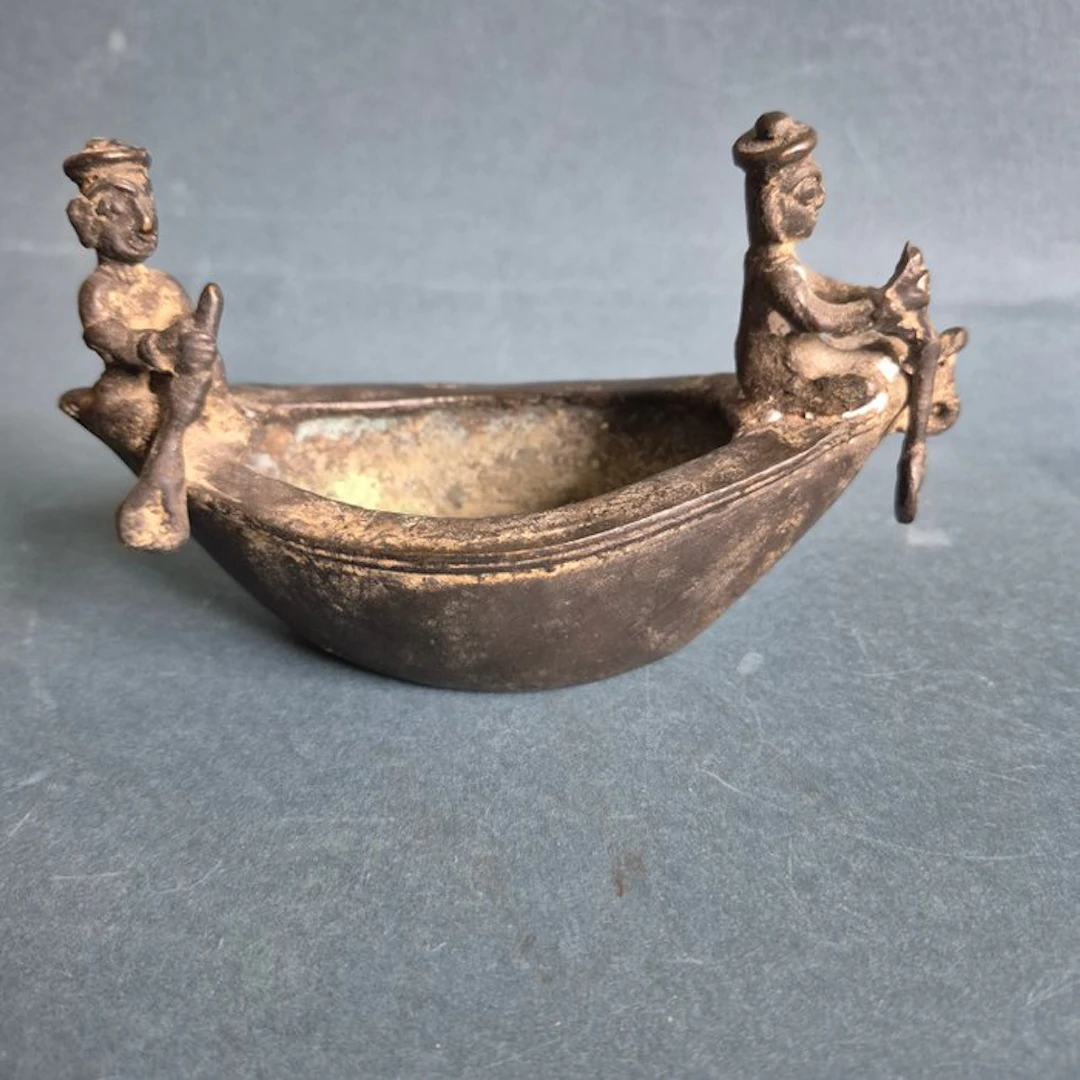
Historic Dhokra boat with two oarsmen – Bronze/Bronze-casting – India – late 19th / early 20th century – old private collection Historic Indian Dhokra sculpture in the form of a long, traditional boat with plastically worked human figures. The piece comes from an old private collection and is dated to the late 19th to early 20th century. The stylistic language, with highly stylized figures, distinctive headdresses, animal motifs, and the narrative depiction of communal life, can be particularly well associated with the Bastar Dhokra tradition of central India, in today's state of Chhattisgarh. This region is known for its traditional metal casting and its characteristic tribal and folk art. The Dhokra technique is a metal-casting process that is over 4,000 years old. In the past, tribes used such sculptures as ritual or spiritual objects. Today, these works of art serve as popular decorations and valuable collectibles. The object shows a traditional boat with several figures holding long oars or paddles. The ends of the boat are sculpted; at the prow there is a distinctive animal head. Several parallel lines structure the gunwale and emphasize the handcrafted character of the casting. Dhokra is one of the oldest continuously practiced metalworking traditions in India. The works are created using the wax casting process, or the lost-wax technique. In this method, the desired object is first modeled in wax and then transferred into a metal object using a single-use casting mold. Each piece thus possesses unique surface and casting characteristics. Dhokra works were produced especially by specialized metalworkers in various tribal regions of India. Typical motifs include people, animals, musicians, riders, and scenes of daily and communal life. The depiction of a boat shared by multiple people is commonly associated with the ideas of community, cooperation, and moving forward together in the contemporary interpretation of such Dhokra motifs. At the same time, the motif directly points to daily life in regions shaped by rivers and waterways. The object is made of a copper-containing metal alloy, bronze or brass, and shows a pronounced dark brown to almost black patina. Greenish oxidation traces can be observed inside and at certain spots. The irregular modeling, casting texture, wear and aging traces correspond to the traditional handcrafted character of the piece. Chronologically, the dating places the object in the late colonial period of British India (British Raj). This refers to the historical period rather than a dynastic art style. Artistically, the piece belongs to the traditional Indian Dhokra or tribal and folk art of central India. Origin: India, presumably Central India / Bastar region Cultural attribution: Bastar Dhokra tradition Dating: late 19th / early 20th century Historical period: British India / British Raj Material: bronze or brass, copper-containing alloy Technique: traditional wax casting / lost-wax process Motif: boat with several human figures and animal head Weight: approx. 430 grams Provenance: old private collection Condition: age-appropriate with pronounced patina, oxidation, wear, and usage marks; see photographs.
Estimación:€20
Ir a la subastaVer todos los artículos deCatawikioArte Antiguo