
Todas las subastas / Fotografía / Jean Boullet (1921–1970) - Retrato de Jean Marais?

Jean Boullet (1921–1970) - Retrato de Jean Marais?
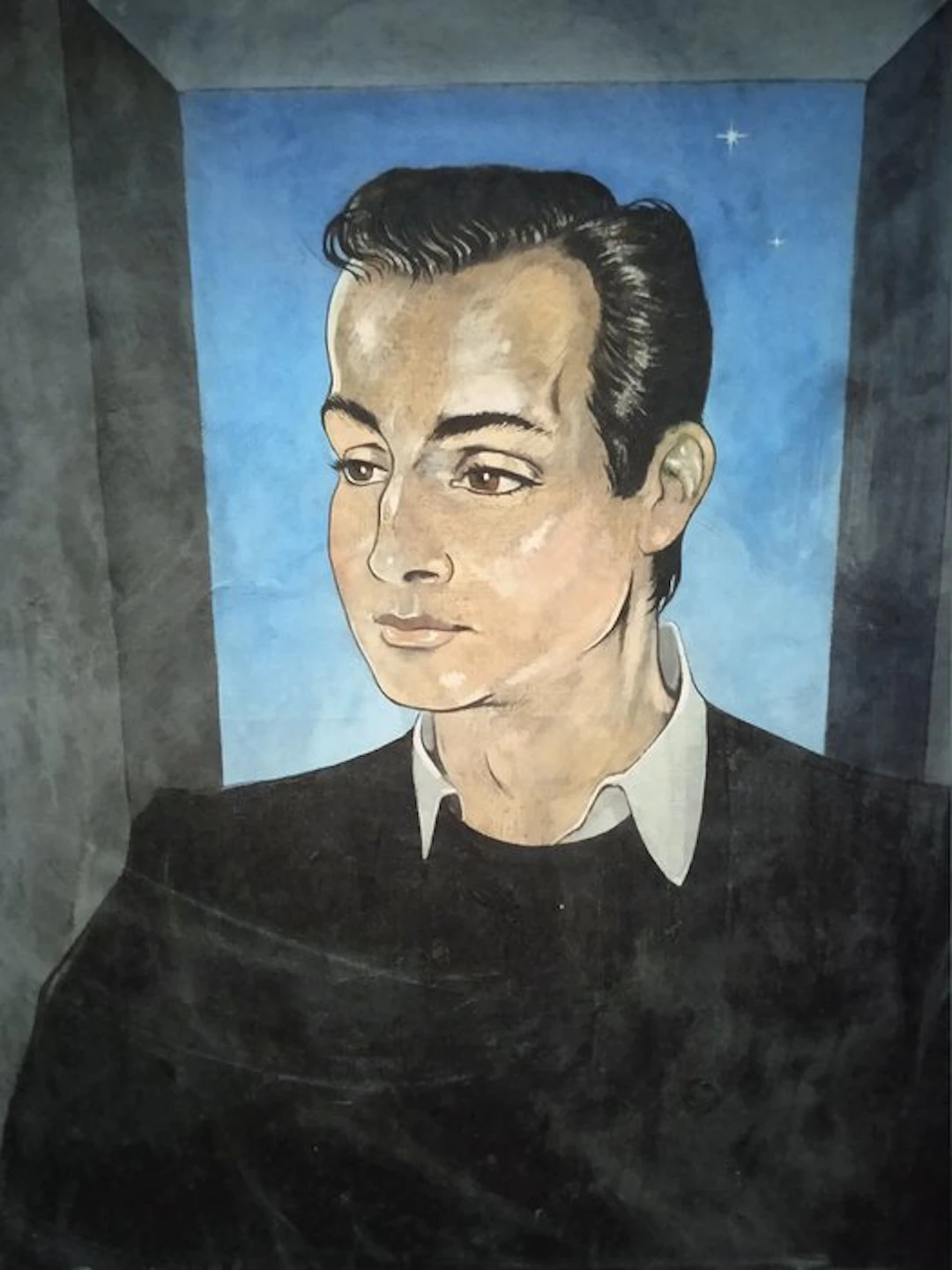
Lot Description .Author: Jean Boullet The market price of authentic Jean Boullet works varies substantially depending on the technique used, generally ranging in the following brackets of bidding on international art auctions: .Suggested title: Portrait of Jean Marais (Portrait of Jean Marais) .Type of Work: Painting .Epoch / Period: Circa 1950–1955 (Postwar period and the artist’s peak activity in Paris alongside the circle of Jean Cocteau) .Technic: Oil on canvas .Dimensions of the work (Canvas): 80 x 63 cm .Dimensions with frame: 96 x 78 cm .Inscriptions: Signed (Jean Boullet) "Signed at the bottom left" .Subject portrayed: Jean Marais (1913–1998), legendary French actor, star of Jean Cocteau’s Beauty and the Beast, and a frequent muse in Boullet’s pictorial works and homoerotic drawings. .Iconographic Description: "In the upper plane of the composition, directly over the head of the portrayed, a square opening in the form of a window or frame is integrated, enclosing two asymmetrical stellar motifs. This element lends the work an allegorical and hermetic dimension, interpreted as a double allusion: on one hand to the actor’s theatrical and cinematic universe; on the other, a symbolic reference to the artistic heraldry of Jean Cocteau and to the spiritual/affectionate guidance that linked the painter with the Saint‑Germain‑des‑Prés circle." Indeed, this is a work by the French artist Jean Boullet (1921–1970). Boullet was a painter, draftsman, illustrator and film critic in postwar Paris. He stood out in the Saint‑Germain‑des‑Prés cultural scene for his prolific production of portraits and illustrations with a strong homoerotic focus. The painting’s style, which combines clean, stylized line drawing with a symbolic or melancholic atmosphere, shares a very close relationship with the visual universe of his friend and contemporary Jean Cocteau. Biography Jean Boullet (1921–1970) was one of the most distinctive, multifaceted and subversive figures of the mid-20th century Parisian avant-garde. Proudly self‑defined as "the painter of masculine beauty," his life and artistic output openly challenged the conventions of his era. Biographical Summary: The Bohemia of Saint‑Germain‑des‑Prés .Origins and Rise (1921–1945): Born in Paris to a modest family, he began autodidactic painting around 1942. After the Liberation of Paris, he quickly became an essential character of the vibrant Saint‑Germain‑des‑Prés district. .A Brilliant Circle: His charisma led him to form friendships and closely collaborate with the era’s brightest minds: Jean Cocteau, Boris Vian (for whom he illustrated the controversial novel J’irai cracher sur vos tombes), Édith Piaf, Juliette Gréco and underground filmmaker Kenneth Anger. .Other Passions: Boullet did not only paint; he was a renowned film critic and a scholar of fantastic and horror literature. He founded the legendary magazine Midi-Minuit Fantastique. Artistic Style and Visual Characteristics Jean Boullet’s visual language stands out for a unique fusion of classical French elegance and dark symbolism, characterized by the following key features: .LINE and Drawing Emphasis: Directly influenced by the clean, poetic stroke of Jean Cocteau, Boullet’s style is defined by a highly defined graphical line. His contours are firm, stylized and almost sculptural, isolating the figures from the background with great clarity. .Idealization of Masculine Anatomy: He was a pioneer of modern homoerotic aesthetics. His models (sailors, boxers, suburban youths, and actors like Jean Marais) are depicted with angular features, melancholic or defiant gazes, and an idealized but robust sensuality. .Symbolic and Sobriety-infused Atmospheres: In his oil paintings, he often uses reduced color palettes, with flat or geometric backgrounds in blues, grays, and blacks. These backgrounds strip the portrait of a realistic context and elevate it to a poetic, mystical, or cinematic dimension. .Usage of Esoteric Codes: It was common for Boullet to introduce symbolic elements loaded with meaning in his portraits, such as stars, roses, daggers or mythological motifs, reflecting his obsession with occultism and the fantastical. His 1944 oil is a pure example of this peak period, where the sobriety of the portrait, the clarity of the lines and the star’s complicity pay homage to the shared aesthetic of his intellectual circle. The Portrayed Person: The Actor Jean Marais Yes, it is highly probable that the portrayed figure is the renowned French actor Jean Marais. There are solid historical, biographical, and iconographic reasons supporting this hypothesis categorically: 1. The Close Relationship with Jean Cocteau’s Circle Jean Boullet belonged to the intimate circle of friends of the poet, dramatist and filmmaker Jean Cocteau. Jean Marais was Cocteau’s great love, muse, and preferred actor (star of classics like Beauty and the Beast and Orpheus). Because of this proximity, Boullet frequented Marais’s dressing rooms and maintained an artistic fixation on him. It is documented that Boullet portrayed Jean Marais face-on and in profile for several consecutive years, making him one of his most recurrent male models. 2. Date Coincidence: 1944 The signature on the work includes the year 1944. In that exact year, Jean Marais was at the peak of his youth and was the absolute standard of idealized masculine beauty in postwar Paris, which perfectly fits Boullet’s aesthetic obsession as a self-proclaimed "painter of masculine beauty." 3. Evidence in his Catalogue of Works There are other oil paintings registered by Boullet explicitly dedicated to the actor. Notable pieces auctioned under titles such as "Jean Marais contre Assane Diouf" or the "Portrait à la rose de Jean Marais." In all of them, Boullet repeats the same physiognomy: angular features, melancholic gaze and the use of iconic high-collar garments or tight sweaters. The Symbolic Element: The Star A fundamental detail in the painting is the five-point star on a blue background. The star was the iconic symbol and personal graphic signature of Jean Cocteau. That Boullet painted this man framed next to Cocteau’s star is a direct visual code and a tribute to the famous couple, which practically confirms Jean Marais’s identity as the portrait subject. The star is not absolute legal proof, but in the painting’s context it functions as an indisputable visual code. In the artistic practice of 1940s Paris, placing a five-pointed star next to that masculine face equated to stamping an identity mark. The meaning of this symbol unfolds in the following points: 1. The Graphic Signature of Jean Cocteau Jean Cocteau did not sign his letters, poems, drawings, or dedications solely with his name; he always traced a five-pointed star next to or in place of his signature. For the entire cultural environment of the time, the star was the public direct synonym of Cocteau. 2. Jean Marais, "The Eternal Star of Cocteau" The romantic and professional relationship between Cocteau and Jean Marais was common knowledge in Parisian bohemia. In Cocteau’s poetic language, he often referred to Marais as his "good star" or the center of his universe. By extension, critics and friends of the couple —such as Jean Boullet— adopted the star as a symbol to represent the bond between them. 3. The Purpose of Jean Boullet in 1944 When painting this oil in 1944, Jean Boullet was not painting a landscape or a generic portrait; he was portraying the man who embodied the era’s beauty ideal. Placing Cocteau’s iconic star right behind Jean Marais’s head is a deliberate tribute to the most famous couple within his own circle of friends. It is a subtle and poetic way of saying: "This is Jean of Cocteau." Not in a general or documented way in his standard portraits of Jean Marais (such as the famous Portrait à la rose). However, the inclusion of two stars (one large and one small) on a canvas linked to this artistic circle carries a very high symbolic charge that could be due to three key reasons: 1. The signature-emblem of Jean Cocteau Jean Cocteau (Marais’s partner and protector of Jean Boullet) had as his indisputable personal signature a star. In this trio’s universe, the star is not a merely decorative element. .If the oil includes stars, it could be an explicit homage to Cocteau integrated by Boullet into the portrait’s background. It could also indicate that the painting was a collaborative work or directly dedicated to Cocteau ("the star of the group") and to Marais. 2. The esoteric symbolism of Jean Boullet As a great student of occultism, demonology and astrology, Boullet frequently used celestial elements in his less commercial works. Two dissimilar stars often symbolize in hermetic language: .The macrocosm and the microcosm. .The duality or guidance (like the Polaris and a secondary star), a concept closely tied to navigation and the sailors’ aesthetics he so often depicted. 3. An unpublished piece or workshop variant Since Boullet’s oils are extremely scarce (his main production was drawings on paper), the background details of his canvases—such as those two stars—are often the key that allows experts to identify the exact year of execution or the Cocteau poem/work that inspired the painting. Iconographic Description: Portrait in the abstract/night background, highlighting the two asymmetrically sized stars (one larger, one smaller) within a frame or window above Jean Marais’s head, a symbolically rich element frequently associated with Jean Cocteau’s iconography and Boullet’s mysticism. The presence of two stars (one large and one small) inside a square frame or window above Jean Marais’s head is an iconographic element of enormous value for cataloging this painting. In the symbolism shared by Jean Boullet, Jean Marais and their circle, this detail has a precise theological and artistic explanation: 1. The symbolism of the "Frame or Window" (The Theater and Destiny) In postwar Paris portraits, placing a frame or window at the top, floating above the subject’s head, was used as a scenic device or a "picture within the picture." .It works as a representation of destiny or the portrayed person’s mind. .It is a clear allusion to the world of theater and cinema in which Jean Marais shone, turning the abstract background into a poetic decor. 2. The mystery of the two stars: Cocteau and Marais As mentioned, the star is Cocteau’s universal and indivisible signature. In painting Jean Marais (who was Cocteau’s great love and muse), with two unequal stars in a window above his head, Boullet is visually rendering the mystic hierarchy of the couple: .The large star: Represents Jean Cocteau himself, the "star king," the mentor and intellectual guiding the artistic circle. .The small star: Represents Jean Marais (or their romantic bond), protected or illuminated by the larger star within that "window to the spiritual plane." 3. The connection to Beauty and the Beast (1946) Jean Boullet was deeply obsessed with the Cocteau-penned, Marais-portrayed film Beauty and the Beast. In the film’s imagination, magic, celestial elements and the "windows that look toward other worlds" are fundamental. Boullet often incorporated these esoteric cues into his oils to elevate a simple profile into a mythological allegorical work. That the stars are straight, simple, and white is the final confirmation of the "Cocteau connection" in this oil. This minimalist style corresponds to a strict codification within the postwar French art movement: 1. The pure Cocteau Star Jean Cocteau did not draw complex or realistic stars; his graphic signature (made compulsively in his letters, manuscripts and drawings) consisted precisely of that: straight lines crossing with simple, quick strokes. By painting those two white, linear stars, Jean Boullet is "tattooing" the painting’s background with Cocteau’s identity stamp. It is an explicit acknowledgment that the portrayed character, Jean Marais, belongs to the poet’s universe. 2. Meaning of the color white In existential and avant-garde painting of that era, white on a dark or abstract background (within a window) was used to denote: .Non-materiality or spirituality: The stars do not belong to the portrait’s physical world; they are mental or mystical projections. .Purity and light: The white, clean strokes act as a beacon or poetic guide over the portrait, a device also used by Cocteau to refer to the "angel" or destiny. Cataloging Notes and Market Value 1. Rarity and Support: The vast majority of Jean Boullet’s preserved production consists of ink drawings, pencil or charcoal on paper. An oil on canvas of this size (80 x 63 cm) is an extremely rare piece in his catalog and possesses a commercial value intrinsically higher than his graphic works. 2. Thematic Context: The oil portraits that Boullet made of Jean Marais (such as the famous Portrait à la rose, 100 x 82 cm) are characterized by an idealization of the actor. They highlight masculine beauty with sharply polished features and the inclusion of subtle fetichist or anatomical details very typical of the author. 3. Importance for Appraisal: Being a signed mid-large canvas portraying one of the most important figures in 20th-century French culture, this piece directly qualifies for evaluation at prestigious international auctions. Its natural market focuses on collectors specializing in 20th-century art and homoerotic aesthetics. Market appraisal: .Large-format oil paintings (such as masculine portraits or sailor themes) are among the rarest and most valued pieces of his production, reaching ceilings close to €8,000 in specialized auctions for exceptional copies. Factors that Alter its Value 1. Identity of the Portrait Subject: If the person depicted belonged to the era’s artistic circle (figures linked to Jean Cocteau, Edith Piaf or French cinema), the value increases substantially. 2. Condition: Since these are 20th‑century works, the absence of damp, cracks in the paint, or damage to the support is key to defending the maximum price. For the specific Jean Marais portrait for sale, an oil on canvas 80 x 63 cm, 96 x 78 cm with frame and signed: The technical and market reasons supporting this valuation are: .Format and Prestigious Support: Large oil canvases (80 x 63 cm) are markedly rarer and more important within his catalog than his abundant paper drawings. .Tematic Value: The stylized postwar portrait with a poetic background is one of the most sought-after themes by collectors of Boullet and the Jean Cocteau avant-garde circle. .Frame Value: Including a period, well-proportioned frame (96 x 78 cm) that complements the piece’s aesthetics consolidates its market price to the higher end of the estimated range. The world’s leading expert on Jean Boullet’s work and the person who has rescued his legacy from anonymity is Nicole Canet, gallerist, researcher and director of the famed Galérie Au Bonheur du Jour in Paris. I contacted her regarding the Jean Boullet portrait (I sent her the portrait images): Demande d'information et de catalogage – Huile sur toile de Jean Boullet (Portrait de Jean Marais?) To which she replied: Bonjour Monsieur, I thank you for your inquiry. This painting indeed seems to be by Jean Boullet, but it is not Jean Marais, who is blond, with a different face. Boullet painted acquaintances in his circle; this painting is the case. Probably a commission. Paintings representing commissions made to J. Boullet sometimes go up for public sale, where this painting will surely find a buyer. In any case, thank you for showing it to me. Kind regards - Nicole Canet https://www.aubonheurdujour.net/peintres-illustrateurs/jean_boullet/
Estimación:€3,000
Ir a la subastaVer todos los artículos deCatawikioFotografía
Estimación:
€3,000
Artículos similares



Resultados de subastas para artículos similares



SANNA SJÖSWÄRD. Amanda Ooms, pigment print.
10/09/2026
€53.55
Est.: €313.07
¡Lleva tu subasta a coleccionistas de todo el mundo!
Publica ahora