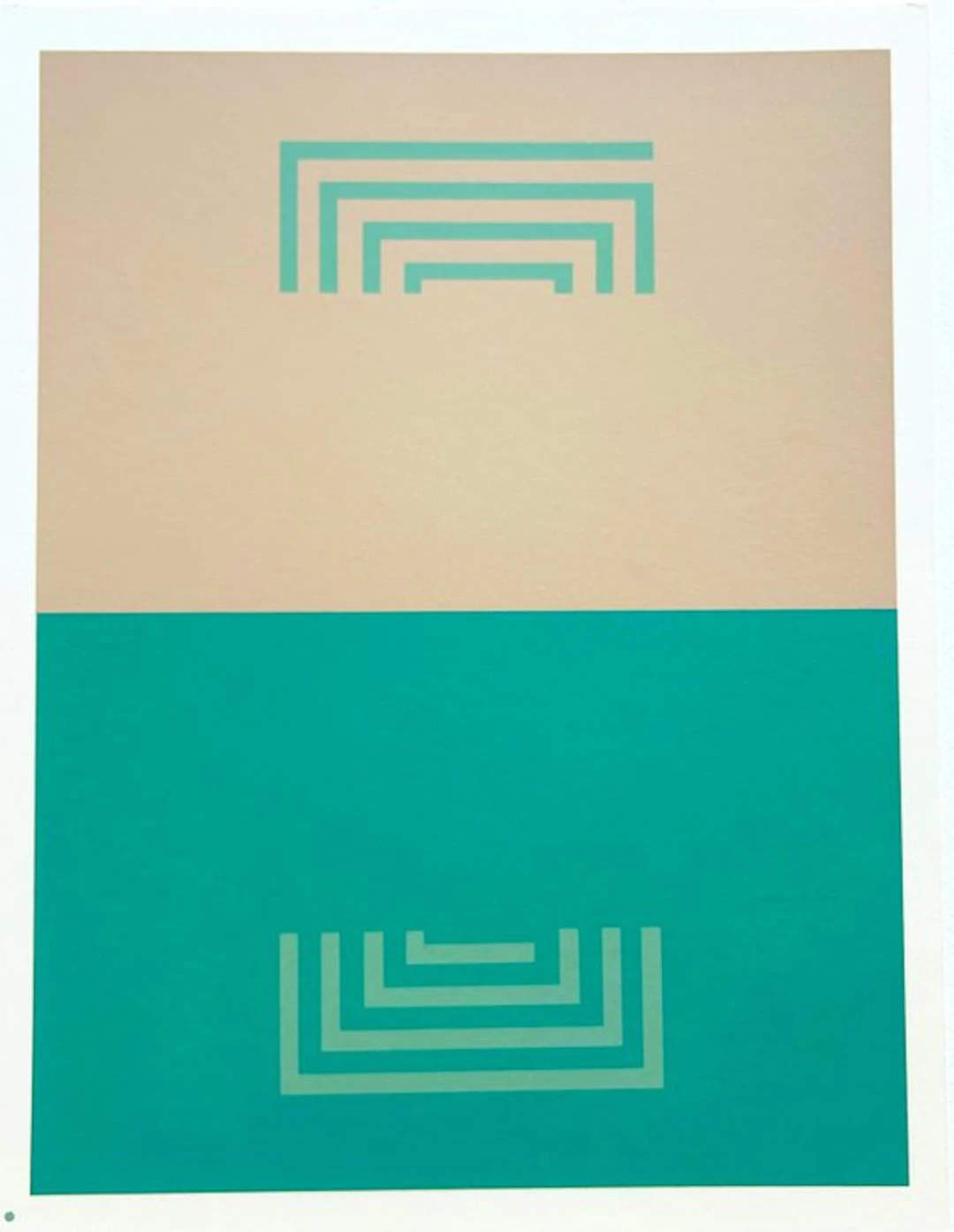
Josef Albers (1888-1976) - Interaction of Colors - VI-2
One-color screen print by German-American artist Josef Albers (1888 Bottrop - 1976 New Haven, CT), from his portfolio 'Interaction of Color' (1973), published by Josef Keller Verlag, Starnberg (ed.) on the kinship and influence of colors on themselves and on each other. Features: - From the portfolio 'Interaction of Color' (1973) - Serial number: VI-2 - 25 x 33 cm - Excellent condition (see photos, which are part of the description) - not signed, unnumbered - portfolio name and serial number on the back of the silkscreen - one silkscreen of the 1000 edition - handmade paper - Provenance: from the original portfolio 'Interaction of Color' and purchased at a recognized/reputable art auction (Germany) (!) The last sheet (in the photo) is not included. This back side contains only a pencil monogram of the title (no printed text). Extra information about Josef Albers: Josef Albers (1888–1976) was an influential German-American artist, designer, and art educator, best known for his groundbreaking research into color and perception. He began his career as a lecturer at the Bauhaus in Germany, where he taught glass, design, and visual theory. After the Bauhaus was closed by the Nazi regime, Albers emigrated to the United States in 1933. In America he became a key figure in modern art and art education. He taught at Black Mountain College and later at Yale University, where he influenced an entire generation of artists and designers. Albers believed that color is relative and dependent on its surroundings—a notion he studied systematically in his art and teaching. His most famous work is the series Homage to the Square (1950–1976), in which he explored the interaction and illusion of color with simple geometric shapes and carefully chosen colors. In addition to painting, Albers also worked with graphics, photography, and furniture design. His theoretical book Interaction of Color (1963) remains a standard text in art and design education worldwide. Josef Albers is seen as a key figure in the transition from European modernism to postwar American abstract art. Josef Albers’ Interaction of Color is not a traditional color theory with fixed laws or schemes, but a fundamental investigation into how color is perceived. For Albers, color did not exist as an objective given: color is always relative and changes depending on its context. His central conviction was that color "almost never is what it seems." Rather than explaining colors through physics or color wheels, Albers started from the experience of looking itself. He concluded that color can only be truly understood through observation and experiment. Therefore he did not have his students paint, but work with colored paper: cutting, moving, and comparing. The eye had to be trained, not memory. A core idea in Interaction of Color is that colors continually influence each other. When two colors stand next to each other, they change each other’s appearance. This principle of simultaneous contrast means that the same color can appear lighter, darker, warmer, or cooler depending on the context. Thus a neutral gray can look cool beside red and warm beside blue, without the gray itself changing. Albers also showed how color can deceive the eye. Two different colors can appear identical, while one color may appear as two different colors. These visual illusions were not tricks to him, but evidence of how unreliable our perception can be. Color is not a fixed fact, but an event arising in the relationship between colors. He also explored how color can suggest transparency and spatiality on a completely flat plane. Through careful color choices, a form may appear to lie in front of or behind another, or a transparent effect may arise without real transparency. This insight proved especially influential later in abstract art, graphic design, and architecture. Constraint played a crucial role in Albers’ method. By using fixed shapes and simple compositions—such as in his famous series Homage to the Square—he directed all attention to the interaction between colors. Form was subordinated to perception. The book Interaction of Color, published in 1963, is organized around exercises, examples, and observations. It is not a theoretical manual, but a practical learning tool inviting readers to look and discover for themselves. Its influence extends to today, across painting, graphic design, fashion, interior design, architecture, and digital interfaces. Albers’ lasting message is simple but radical: color is the most relative medium in art. Those who work with color do not deal in certainties, but in perception, context, and experience. Albers was associated with the following artists: Paul Klee, Wassily Kandinsky, László Moholy-Nagy, Johannes Itten, Oskar Schlemmer, Theo van Doesburg, Piet Mondrian, Kazimir Malevich, Anni Albers, John Cage, Robert Rauschenberg, Cy Twombly, Ellsworth Kelly, Frank Stella, Agnes Martin, Ad Reinhardt, Victor Vasarely, Bridget Riley, Sol LeWitt, Max Bill.
Estimación:€150
Ir a la subastaVer todos los artículos deCatawikioArte, Pintura & obra gráfica